Gazetteer:
The Woad Woods.
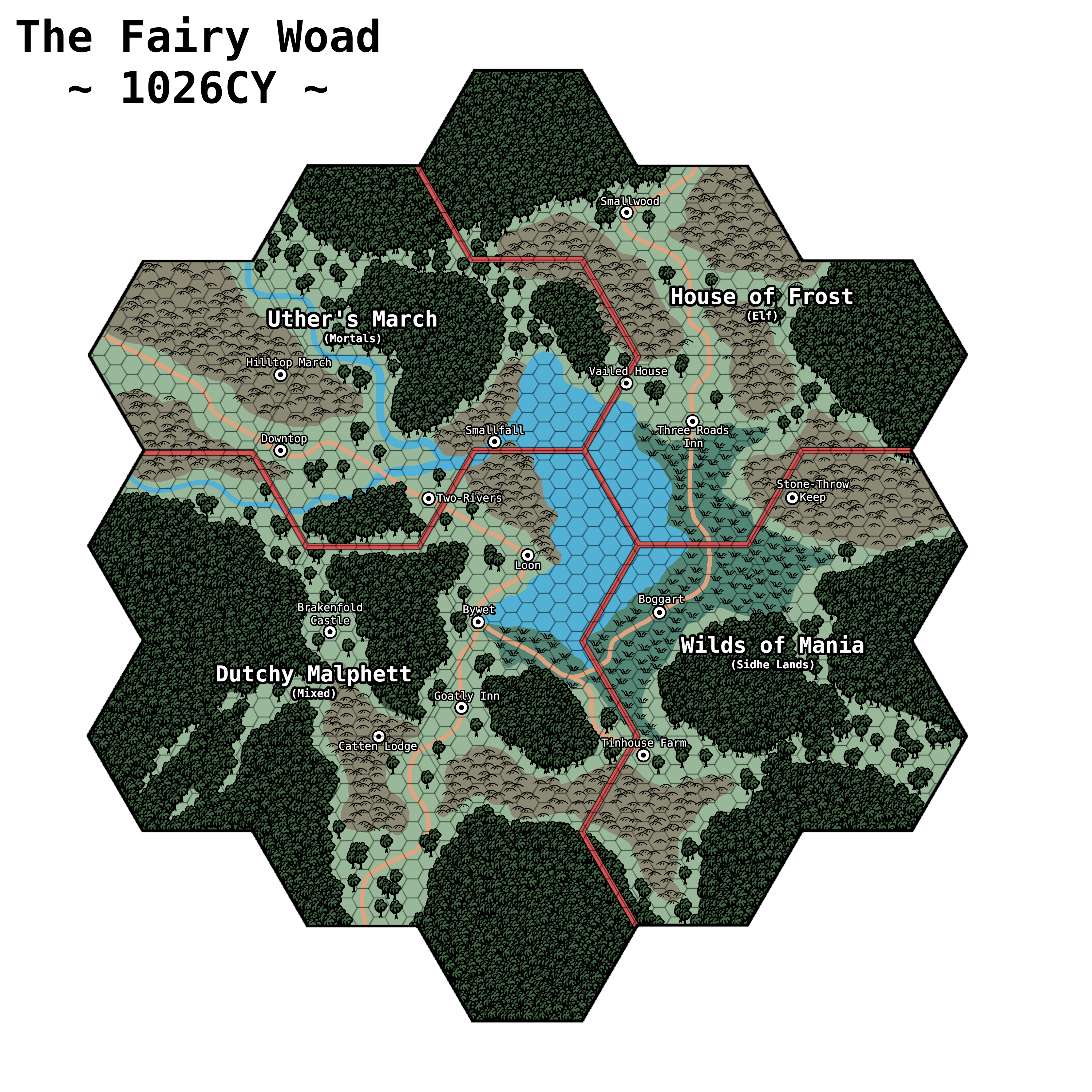
The Woad is a land of borders; between mortal and fae, order and wildness, memory and forgetting. Its rivers and roads bind together realms of starkly different temperaments: austere hills held inviolate by ancient houses, fertile valleys claimed by conquering kings, maddened wilds that devour names and paths alike, and bustling duchies where mortal hands and fae cunning labor side by side. Nowhere in the Woad is the land truly tame, nor entirely lost to chaos; every holding bears the mark of intention pressed against older, willful earth.
Travel within the Woad is never without consequence. Roads may lead to trade and shelter, yet just beyond them lie places where silence watches, banners promise more than they deliver, and the land itself remembers every trespass. Power here is measured not only in soldiers or crowns, but in patience, custom, and the favor, or indifference, of forces far older than any throne. To enter the Woad is to step into a region alive with quiet tension, where history is unfinished and every realm stands upon the brink of change.
Lwo, the Curator
None may truly enter the Woad without first understanding its patron fairly lord, for above invading mortals and proud fae alike there rules a single, inscrutable master: Lwo. Though crowns rise and fall and banners advance and retreat, all dominion within the Woad exists by Lwo’s sufferance. In temples, roadside shrines, and half-forgotten groves, Lwo is depicted as a grand owl, wings spread wide in moments of wrath and drawn inward, nesting, when calm. Madmen, prophets, and those touched too closely by the land insist that Lwo’s eyes burn with a psionic violet light, a gaze that pierces flesh, memory, and intention alike.
Lwo is a seeker of myth and legend, a storyteller unto themself, and a patron of the arts in their most perilous form. The lives of the Woad’s inhabitants are not merely observed but curated, shaped into narratives through subtle manipulations of fate, element, and soul. Wars ignite, paths collapse, meetings occur by chance alone; yet all serve to call chosen figures, whom Lwo deems heroes, into motion. Adventure, trial, and transformation are the coin of Lwo’s interest, and boredom is the only true sin.
Yet Lwo is not without law, though such laws are rooted in tradition and drama rather than mercy or justice. As patron of the theatrical, Lwo is exacting in matters of form and symbol. It is said that an audience must never witness an actor don a mask; should this rule be broken, the mask shall fuse forever to the wearer’s face, becoming truth instead of costume. Likewise, when one dares meet Lwo’s gaze, the lord does not demand worship or fealty, but merely a tale; a story of truth, risk, and lived adventure. If the telling satisfies, Lwo may grant a blessing; if it does not, the silence that follows is often punishment enough.
Wilds of Mania
The Wilds of Mania are a realm of maddening wilderness, rife with strange monsters and stranger folk, a land claimed by neither mortal nor fae and long kept secret beneath a pall of shadow, twisting bramble, and sucking bog. Untamed and willful, the region resists all dominion, swallowing roads and erasing boundaries as swiftly as they are drawn. Yet even here, a few paltry efforts at civilization cling to the margins. To the south lies Tinhouse Farm, a meager holding and a sorry attempt at expansion by the Duchy of Malphett, its fences forever gnawed by rot and vine. Near the heart of the wetlands stands Boggart, a waystation of ill repute, infamous for its scum and criminal underworld, a place best avoided by any who value their coin, their name, or their life. Far to the north, upon the stony hills, rises an ancient stone keep now occupied by an order of mages known as the Sidhe, attended by a retinue of mortals whose minds have been fractured by prolonged exposure to the land’s peculiar humors.
It is not the monsters or beasts one should most fear in the Wilds of Mania, though they are plentiful enough. Rather, it is the land itself that stands as the true adversary: living vines creep and constrict, the earth shifts and betrays the unwary, and the very paths conspire to cast travelers into the depths of the wilds, where the region’s mysteries take hold and whisper secrets that cling to a soul as tightly as a name once spoken aloud.
Uther’s March
To the north-west lies a contested marchland now firmly claimed by a great levy of mortal knights, who fly the crimson-and-gold banners of King Uther. This is a harsh and watchful territory, thinly peopled and ruled by steel and oath rather than ancient custom. Though proclaimed secure, the region yet trembles beneath the weight of recent conquest.
The region is defined by a long, defensible valley, hemmed in by two broad hill-ranges to the north and south. These natural ramparts create rich farmland and a single dominant roadway running the length of the vale. This road is the artery of the march and the linchpin of Uther’s ambitions, leading westward toward the Kingdom of Pridwyin, from which trade caravans, mercenaries, and would-be settlers flow steadily into the lands bordering the Woad.
The march contains but three principal holdings, each valued for strategic necessity rather than civic comfort. The Hilltop Keep stands foremost, a grand citadel and the undisputed heart of Uther’s dominion, crowning the highest ridge of the valley so that its towers command every road, field, and crossing below, from which the king’s captains dispatch patrols, levy taxes, and scheme further expansion. Below it lies Downtop, a modest village and agricultural hub nestled in the central valley, whose fertile fields, made so by sheltering hills and the toil of pressed farmers feed the entire march, even as its folk live under constant requisition and fear both knight and outlaw alike. Last is Two-Rivers, the newest and most uneasy addition, a town surrendered to Uther as the price of peace after the last war, standing just south of a confluence of twin waterways and serving equally as a trade post and a living reminder that the peace of the march was purchased, not earned.
Despite its fortifications and banners, the march remains scarred by the knights’ first incursion. Old battlefields lie scattered across the hillsides and low fields alike, their rusting arms and unburied bones now home to scavenging beasts and desperate men. Ruined hamlets and broken watchposts stand as mute testimony to the cost of conquest.
Though knights and men-at-arms are ever present, order is far from assured. Brigands roam the byways with alarming freedom, thriving in the confusion of shifting rule and half-enforced law. Justice here is swift when it comes, but uneven, and many crimes vanish unremarked amid the greater ambitions of kings.
Dutchy of Malphett
The Duchy of Malphett stands as the closest approximation of a civil realm within Faerie, a land where mortal and fay dwell side by side in uneasy but productive accord. By the deliberate blending of mortal industry and fae craft, the duchy has grown into a thriving metropolitan landscape, its grand forests, rolling hills, and deep woods punctuated by villages, way-stations, and bustling towns linked by well-worn roads and ancient paths alike.
The richness of the land grants Malphett unmatched access to timber, stone, and fertile soil, resources that have fueled its prosperity and drawn traders from across the Woad. Foremost among its settlements is Bywett, a large and celebrated town upon the southern shore of the Woad Waters, where a mortal might find hearth and hall familiar, even as a fae finds ample space to tinker, enchant, and trade in stranger wares. Bywett stands as the duchy’s beating heart, a place where two worlds meet with more commerce than conflict.
Yet all is not bliss within Malphett. The duchy suffered a bitter defeat when Uther’s swarm descended upon the region, culminating in the Battle of Loon, where Duke Malaroolu Malphett IV was slain. In the aftermath, his heir, Garificus Malaroo-Lancast Malphett II, was forced to bend the knee to the occupying knights, securing survival at the cost of sovereignty. Since that day, Duke Malphett has rarely left his castle deep within the Dark Wood, emerging only for matters of great ceremony or dire necessity, while his once-proud duchy endures beneath the shadow of foreign banners and unquiet loyalties.
House of Frost
Resting in the north-eastern marches of the region lie the rolling hills known collectively as the House of Frost. The land is spare and austere, its pale swells of turf and stone cleft in twain by a single great roadway, ancient and well-kept, which bears northward into the elder realms beyond mortal charting. Winds here are constant yet gentle, and silence reigns with a weight that presses upon the unaccustomed traveler.
Life within the House of Frost proceeds at a glacial pace; traditional, unchanging, and above all quiet. The notable absence of mortal settlement has, by deliberate design, rendered the land a sanctuary for the lesser fae. Sprites flit among the hill-grass, sprigs root themselves in the shallow vales, and wandering wisps are a common sight at dusk and dawn. Such encounters are frequent and usually benign, yet travelers are sternly advised to remain upon the roadways, for the wild hills conceal entities of far greater puissance, whose interests do not align with mortal safety.
Mortals are seldom seen, and when they are, it is briefly. The House of Frost maintains a cadre of tireless “hunters,” tasked with the removal of all unauthorized intruders from the holding. Faerie folk are more tolerated, yet even they are few, having gathered only in the small northern village of Smallwood, the sole recognized settlement of the region. No towns, cities, nor forts mar these lands, for House Frost refuses utterly to tarnish its domain with population or industry.
Upon the shores of the Woad Waters, just beyond the reach of the hills, stands a grand elven manor of singular beauty, the Vailed House. Fashioned in an art nouveau style of living stone and grown wood, its spires and arches twist organically from the landscape itself, as though coaxed from root and rock rather than built by hand. This is the Winter Manse, ancestral seat of rulership.
Here reside the twin sovereigns of the region: Prince of Winter’s Dawn and Prince of Winter’s Dusk, brothers in blood and burden. In the wake of the rumored death of their mother, the Queen of Winter, whose fate remains unconfirmed; the manor has been sealed against all but the most honored guests. Despite this seclusion, the house presently stands as a beacon of somber activity, for elves from across Faerie now converge upon the Woad Waters to pay their respects, offer fealty, or seek favor in a court poised upon the edge of grief and transformation.
Thus concludes the accounting of the Woad, though no ledger, however careful, can ever truly bind such a land. These regions, their rulers, their roads, and their wounds are but the present shape of a country forever in motion, where ancient powers stir beneath fresh banners and every victory carries the seed of its undoing. What is written here reflects a moment suspended between past and future, a fragile balance held by oath, steel, sorcery, and the will of the land itself.
Let the reader remember that maps lie, roads shift, and names change meaning when spoken in the wrong place or season. The Woad does not suffer certainty for long. Those who would travel it, rule it, or survive it must do so with caution, humility, and a keen respect for what watches from the forests, the hills, and the quiet spaces between settlements. May this gazetteer serve not as a promise of safety, but as a warning: in the Woad, nothing is ever truly finished, and every path leads onward; whether one intends it or not.