San Firenzo
25.07.2026 @ 1600
Quick Look
- A wealthy region of independent coastal city-states.
- Inspired by Venice and the merchant republics of Italy.
- Built around the coast of a vast inland sea.
- Famous for trade, banking, shipbuilding, art, theatre, and luxury goods.
- Each city-state is ruled by a Doge, usually from its strongest family.
- Doges can be replaced through elections, scandal, bribery, exile, or assassination.
- Noble families, merchant houses, guilds, banks, and criminals compete for influence.
- Open war is uncommon; rivalries are usually fought through trade, espionage, privateers, and political plots.
- Wealthy families sponsor artists and public buildings to display their prestige.
- Masks, festivals, contracts, favours, and secret meetings are central to Fiorenzan culture.
- The Fiorentine Range lies to the south-west and supplies timber, stone, metals, and mountain trade routes.
- In San Fiorenzo, nearly everything has a price, even when no money changes hands.
Where every harbour hides a fortune, every palace displays a rivalry, and every smile conceals a negotiation.
San Fiorenzo is a wealthy coastal region formed from a collection of fiercely independent city-states. Although its people share a common language, history, and culture, San Fiorenzo has never been a single unified nation.
Each city governs itself, maintains its own laws, raises its own soldiers, and competes for control of trade across the great inland sea. Alliances between the city-states are common but rarely permanent. A city that supports its neighbour during one war may fund its enemies during the next.
Despite this constant rivalry, the people of San Fiorenzo generally consider themselves part of a shared civilisation. They are united by maritime trade, artistic ambition, political intrigue, and the belief that wealth should be seen as well as possessed.
The region is famous for its shipyards, banking houses, galleries, theatres, universities, masked festivals, and elaborate public buildings. Its merchants can be found in almost every major port, while its artists, architects, navigators, and craftspeople are sought across the world.
Geography
San Fiorenzo lies along the western coastline of a vast inland sea. Its shores are broken by natural harbours, sheltered lagoons, river mouths, and small islands, making the region ideal for trade and shipbuilding.
Most of its major cities were founded around these harbours. Over time, many expanded onto artificial islands, reclaimed marshes, and networks of canals. In the oldest districts, streets are narrow and buildings rise directly from the water.
The climate is generally warm and mild, with long summers and short, wet winters. Vineyards, olive groves, orchards, and farms cover the countryside between the cities, though much of the best land is owned by wealthy urban families.
To the south-west rises the Fiorentine Range, a rugged chain of mountains that separates the coast from the lands beyond. The mountains provide timber, marble, iron, copper, and other resources essential to the cities.
Mountain settlements are more isolated than those along the coast. Many owe loyalty to whichever city-state controls the nearest pass, though this loyalty often lasts only as long as the city can enforce it.
The high roads are dangerous. Bandits, smugglers, mercenary companies, and independent mountain clans all compete for control of the passes.
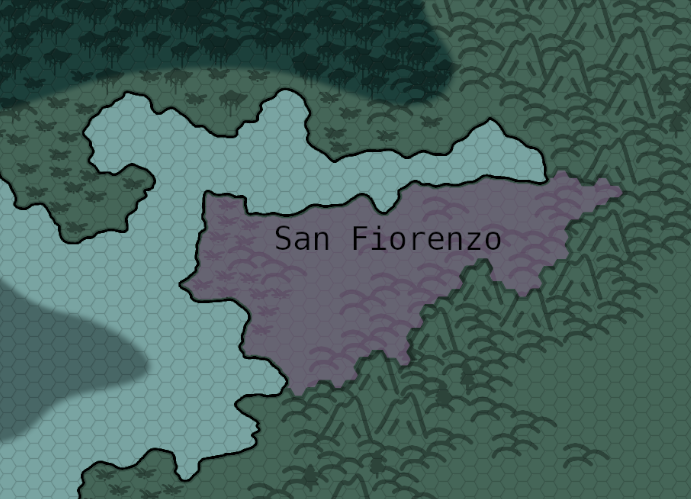
The City-States
Every city-state in San Fiorenzo is effectively its own small country. Each has its own laws, customs, coins, military forces, and ruling families. Some are governed through councils of merchants and nobles, while others are little more than private kingdoms controlled by a single dynasty.
The city-states compete over shipping routes, islands, mines, river access, farmland, and foreign contracts. Open warfare is possible, but most conflicts are fought through trade restrictions, sabotage, espionage, bribery, privateers, and hired mercenaries.
A merchant vessel may be seized without any formal declaration of war. A rival shipyard may burn down under suspicious circumstances. A foreign prince may suddenly cancel a treaty after receiving a generous gift from another city.
These conflicts are dangerous but carefully managed. The ruling families understand that prolonged war disrupts trade, and trade is the source of their power.
As a result, disputes often end through negotiated settlements, political marriages, debt agreements, or the quiet removal of the person responsible.
The Doges
Each city-state is ruled by a Doge, a title traditionally granted to the head of the city’s most powerful family.
In theory, a Doge is chosen by a council representing the city’s noble houses, merchant guilds, banks, temples, and military leaders. In practice, the office usually belongs to whoever can gather enough money, favours, allies, and armed support.
Some Doges inherit their position from a parent or relative. Others rise through elections that are heavily influenced by bribery, threats, and secret agreements. A Doge rules for as long as they remain useful and powerful.
Leadership can change suddenly. A failed war, lost trade agreement, public scandal, banking collapse, or unpopular tax may be enough to bring down a ruling family. Some Doges are forced into exile. Others vanish during the night or die from remarkably convenient illnesses. The removal of a Doge is often followed by the destruction of their public statues, the repainting of family crests, and the rapid rewriting of official history.
A skilled Doge must therefore balance many competing interests. They must satisfy the merchants without angering the workers, reward the nobles without weakening the guilds, and maintain public order without appearing tyrannical. Most importantly, they must ensure that no rival family becomes powerful enough to replace them.
Great Families
The great families of San Fiorenzo are part noble dynasty, part merchant company, and part political faction. A powerful family may control banks, warehouses, ships, vineyards, mines, workshops, newspapers, theatres, and private soldiers. Their influence often extends beyond the city they rule.
Families build alliances through marriage, business partnerships, loans, and shared enemies. Children are raised from a young age to understand that every friendship may become a political connection. Family reputation is treated as a valuable resource. A public insult cannot always be ignored, while a scandal involving one family member may damage an entire dynasty.
Some rivalries have lasted for centuries. In several cities, families continue feuds even though no one remembers how they began.
Smaller families survive by attaching themselves to stronger patrons. They may provide soldiers, votes, information, or commercial support in exchange for protection and opportunities. Betrayal is common, but loyalty is highly valued precisely because it is so rare.
Trade and Banking
Trade is the foundation of San Fiorenzo’s wealth. Its ships carry grain, timber, metals, wine, spices, textiles, glass, art, weapons, and luxury goods across the inland sea. Fiorenzan merchants are skilled at purchasing goods where they are common and selling them where they are scarce.
Many city-states maintain permanent merchant districts in foreign ports. These districts often contain warehouses, banks, inns, shrines, and fortified compounds for visiting traders.
San Fiorenzo is also known for its banking houses. Wealthy families lend money to merchants, nobles, cities, and foreign rulers. A single Fiorenzan bank may finance a war on one side while insuring the trade vessels of the other.
Debt is one of the region’s most effective political weapons. A ruler who owes money to a Fiorenzan bank may find that their decisions are no longer entirely their own.
Trade agreements are considered nearly sacred, though their exact wording is often deliberately complex. Fiorenzan contracts are famous for containing hidden conditions, unusual penalties, and clauses that only become important years after they were signed.
Shipbuilding
The shipyards of San Fiorenzo are among the largest and most advanced in the world.
Entire districts are dedicated to the construction of merchant vessels, warships, fishing boats, and private luxury ships. Timber arrives from the Fiorentine Range and from foreign ports, while iron, rope, sailcloth, and pitch are produced in vast quantities.
The largest shipyards employ thousands of workers, including carpenters, smiths, rope-makers, sail-makers, engineers, and labourers.
Ship design is a closely guarded secret. Skilled shipwrights may be forbidden from leaving their city, while rival states regularly attempt to steal plans or recruit experienced workers.
Many city-states maintain powerful fleets, though these ships are as likely to protect merchants as fight formal wars. Privateers are commonly employed to attack rivals while allowing the city-state to deny direct involvement.
San Fiorenzo’s fleets also protect the inland sea from pirates, though some Doges quietly support pirates who target their enemies.
Arts and Patronage
Art is central to Fiorenzan society. Wealthy families sponsor painters, sculptors, architects, poets, musicians, actors, inventors, and scholars. This support is known as patronage.
Patronage is rarely performed purely out of generosity. A magnificent palace, public fountain, theatre, or temple demonstrates the power and refinement of the family that paid for it.
Rival families often compete through artistic commissions. If one family builds a marble bridge, another may fund an entire public square. If one Doge hires a celebrated painter, their rival may attempt to hire the artist’s teacher, apprentice, or enemy.
Artists can become influential political figures in their own right. A famous portrait may improve a ruler’s reputation, while a mocking play or unflattering statue can destroy it.
Censorship exists, but it is inconsistent. A banned artist in one city may be welcomed as a hero in another.
San Fiorenzo’s streets are filled with colour. Walls are painted with religious scenes, family victories, merchant voyages, and idealised images of city life. Even warehouses and workshops may display elaborate carvings or mosaics.
Festivals and Masks
Public festivals are held throughout the year. These celebrations include boat races, theatrical performances, feasts, religious processions, public duels, masked dances, and competitions between neighbourhoods.
Masks are particularly important to Fiorenzan culture. During certain festivals, a person may conceal their identity and temporarily step outside their normal social position. A labourer might speak to a noble as an equal. A rival family member might enter an enemy’s celebration. Lovers, spies, criminals, and political conspirators all make use of the anonymity.
Although violence during a masked festival is officially forbidden, disappearances are not uncommon.
Many important political agreements are first discussed at festivals, where those involved can pretend their meeting was accidental.
The Foundation and Common Life
The great families dominate politics, but the Foundation control much of daily life, they have signifigant sway in the region and can regulate trade, train apprentices, set prices, protect workers, and maintain standards. The Foundation has grown so strong in San Fiorenzo that is has had to reestablish guilds. Important guilds include shipwrights, glassmakers, painters, masons, merchants, bankers, navigators, smiths, and clothmakers.
A powerful guild may be able to challenge a ruling family by refusing work, raising prices, or supporting a rival candidate for Doge.
The poorest citizens work in docks, workshops, warehouses, farms, and construction yards. Life can be difficult, particularly during trade shortages or political unrest. However, even poorer neighbourhoods take great pride in their local identity. Districts maintain their own festivals, colours, shrines, and rivalries.
Public reputation matters at every level of society. A baker, sailor, or craftsman may be respected throughout their district, while an arrogant noble may find themselves mocked in songs and street performances.
Religion
San Fiorenzo is home to many faiths. Most city-states officially recognise Astra and the wider pantheon, though worship varies greatly between cities. Merchant families commonly sponsor temples in exchange for prestige, political support, or public favour.
Foreign gods and religious traditions are generally tolerated, especially when their followers contribute to trade. A city-state is unlikely to reject a wealthy merchant merely because they worship unfamiliar gods. Faith can still become political. Temple leaders may support particular families, and public religious ceremonies are often used to display the legitimacy of a Doge.
Crime and Power
The line between legitimate business and organised crime is often unclear in San Fiorenzo. Smuggling, protection payments, bribery, illegal gambling, debt collection, and political intimidation are common. Many criminal organisations have connections to noble families, guilds, or government officials.
A criminal group may protect a neighbourhood more effectively than the city watch. In exchange, residents are expected to remain silent and pay for that protection.
Powerful families often employ unofficial agents to perform tasks that cannot be publicly connected to them. These agents may be spies, smugglers, assassins, mercenaries, or respectable merchants with less respectable responsibilities.
Violence is usually controlled. Random killing is considered bad for business. The most successful criminal organisations prefer threats, debt, favours, and reputation to open bloodshed.
Vinnito, the City of golden domes
Vinnito is the largest, wealthiest, and most influential city in San Fiorenzo. Built across a sheltered lagoon, the city is connected by canals, bridges, stone walkways, and crowded island districts. Its skyline is dominated by towers, domes, palaces, shipyard cranes, and the fortified halls of its merchant families.
Vinnito’s harbour is one of the busiest on the inland sea. Goods from across the world pass through its warehouses, while its bankers finance expeditions, governments, and wars.
The city is famous for its shipyards, masked festivals, glassmakers, theatres, and grand public squares. It is also infamous for corruption, political disappearances, and carefully organised crime.
The Saverino Family
Vinnito is currently ruled by the Saverino family. Officially, the Saverinos are an old merchant dynasty whose wealth comes from shipping, banking, construction, and imported luxury goods. Unofficially, they control much of Vinnito’s organised crime.
The family rose to power by presenting themselves as protectors of the city’s poorer districts. They settled disputes, offered loans, found work for loyal families, and punished criminals who acted without permission. Over time this protection evolved into control.
The Saverinos now maintain a vast network of merchants, dockworkers, guild officials, captains, judges, guards, smugglers, and informants. Few major decisions are made in Vinnito without the family learning of them.
Their current Doge rules through a combination of public generosity and private intimidation. The family sponsors festivals, repairs bridges, funds temples, and provides food during shortages. Those who cooperate with them may receive contracts, protection, loans, or political positions. Those who oppose them may lose business, face criminal charges, fall deeply into debt, or simply disappear.
The Saverinos rarely threaten someone directly. Instead, a family friend offers advice, a contract is unexpectedly cancelled, or an unfortunate accident demonstrates what continued resistance may cost.
Many citizens sincerely support the family. Under Saverino rule, the streets are relatively safe, ships arrive on time, and uncontrolled criminals are dealt with quickly. Others believe Vinnito has become a private empire where every institution ultimately serves one family.
Foreign Relations
The city-states of San Fiorenzo prefer trade to conquest. They maintain embassies, merchant houses, and agents across the world. Fiorenzan diplomats are known for offering loans, gifts, and commercial opportunities before making political demands.
The region rarely acts with a single voice. One city-state may support a foreign ruler while another funds their rival. Foreign powers often struggle to understand whether San Fiorenzo is an ally, enemy, or neutral trading partner. In most cases, it is all three.